Ask a City Nerd #1: Rogers Park as Physical Therapy

Welcome to Ask a City Nerd. Got a question you want answered? Or a story I can use as a jumping-off point for lengthy digressions on things I wanted to talk about in the first place? Submit it here! And welcome to installment number one.
Hi City Nerd,
You've remarked on the health consequences of car-dependency many times and I have an anecdote I would like to share.
I grew up in Hickory, NC, which is utterly car-dependent. Even if you live in one of the few downtown apartments, you cannot go without a car; there isn't even a convenience store, much less a grocery store, in downtown or its immediate vicinity.
There are 5 fixed-route buses in the entire county (the Greenway website lists 7 but 2 are just the opposite direction versions of existing routes; 3 routes only run in one direction), and they all have 1-2 hour intervals and run 8 AM - 6 PM. However, I never took the bus because I lived 45 minutes from the nearest bus stop, and in that 45 minute walk, the only non-residential land use you would come across were a church and 2 cemeteries.
Software development isn't exactly known for its physical exertion to begin with, and I also worked from home, so I didn't even get the "workout" of walking across a parking lot. As a result, my muscles steadily degraded, to the point that walking more than a mile would cause my knees to physically hurt if I was not wearing knee braces, and if I walked several miles without them, the pain would be so bad that eventually I could not walk anymore. (I was not overweight, either.)
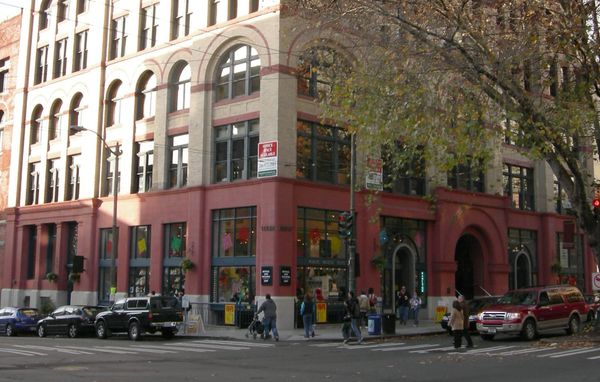
In September 2024, I finally had enough and left North Carolina for the lovely neighborhood of Rogers Park in Chicago. I still work from home, drive to the grocery store, and take the CTA once a week on average, but just walking to the pharmacy, post office, library, meetings with elected officials, farmers market, park, and hairdresser has significantly strengthened my muscles (in particular my quads), to the point that I can log 10 miles in a day and my knees don't hurt at all, much less require braces.
I know that I should have gotten a gym membership and worked out when I lived in North Carolina, but living where I do now, I don't need one. My weight is healthy and my muscles aren't shriveling into nothingness because I get enough exercise just from walking to meet most of my daily needs (and once my car gets totaled and I get that insurance check, I will be relying on my own two feet to meet all of my daily needs). Living in a walkable area saves me money in health and transportation costs, and those savings will only compound with time. It's not just the obvious costs like gas (I last filled up in January and I still have half a tank left), it's about things like inactive muscles being at greater risk for insulin resistance (causing type 2 diabetes), inactive bones losing density (osteopenia; increases risk of fractures), and a lack of muscle mass causing balance issues (sarcopenia).
Seeing the state my grandparents (who still live in Hickory) are in, it is remarkable the sheer amount of health problems they have that could have been prevented if they were to just get a small amount of regular exercise after retiring, and I feel like I dodged a major bullet by putting myself in a position where it is more convenient to get that exercise than it is to find parking when doing those daily chores. I love Chicago and I'm not sure any amount of money could get me to go back to living in sprawlburbia, it is that much of a quality of life boost. Maybe I could be enticed to work in a suburban office park where I have to drive if my salary were tripled, but I cannot go back to being locked in to a car to do literally anything more than check the mail. Being a slave to the car is not freedom, it is suffocating.
Anonymous
My first thought here is, this is a heartwarming story about the virtues of urban living. And it all rings true, but...I also have a lot of questions. Like, for one, I don't know anything about Hickory, North Carolina. And the first thing any sane person does when they hear the name of a geographical location they aren't familiar with is, of course, immediately locate it on a map and investigate.
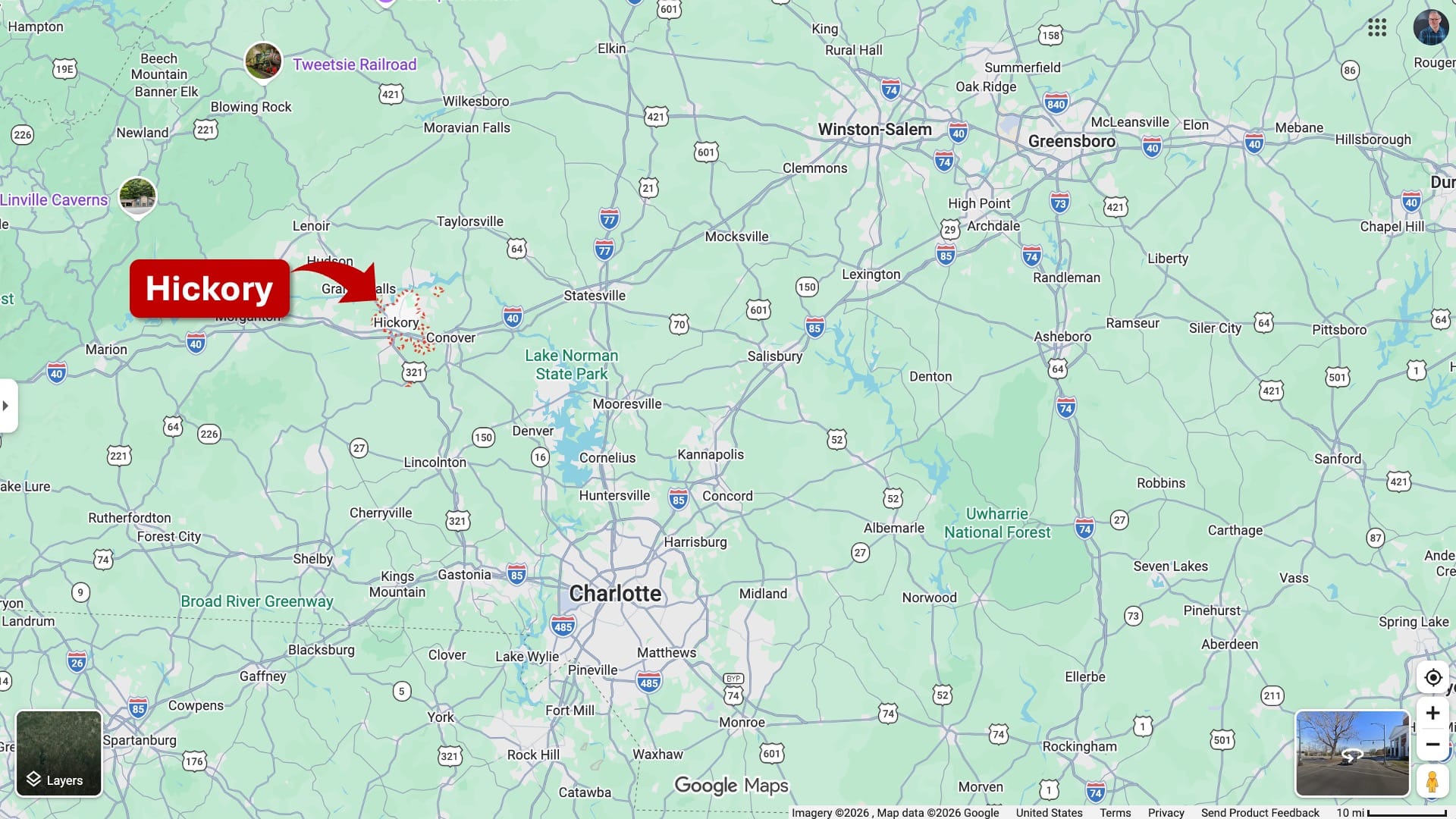
Hickory is about 40 miles northwest of Charlotte, which, in my mind, either puts it just inside the Charlotte Metropolitan Statistical Area (MSA), or close enough to be considered an exurb. This isn't trivial — geographic context is a huge deal! A bit of additional research indicates that Hickory, population around 40,000, is actually the central city of its own MSA of 350,000, but that MSA is considered part of the larger Charlotte Combined Statistical Area (CSA). So, sure, it might be fair to call Hickory an exurb. And even though "exurb" is kind of a made-up term with no census definition, I think it's helpful as far as visualizing the urban/rural context. It isn't a suburb, but it's a city that's close enough to Charlotte's gravitational pull that it has some small town features AND some suburban ones.
I'm actually not here to slander Hickory, a city I had no idea existed until I received this essay/non-question. In fact, the downtown main street looks positively charming.
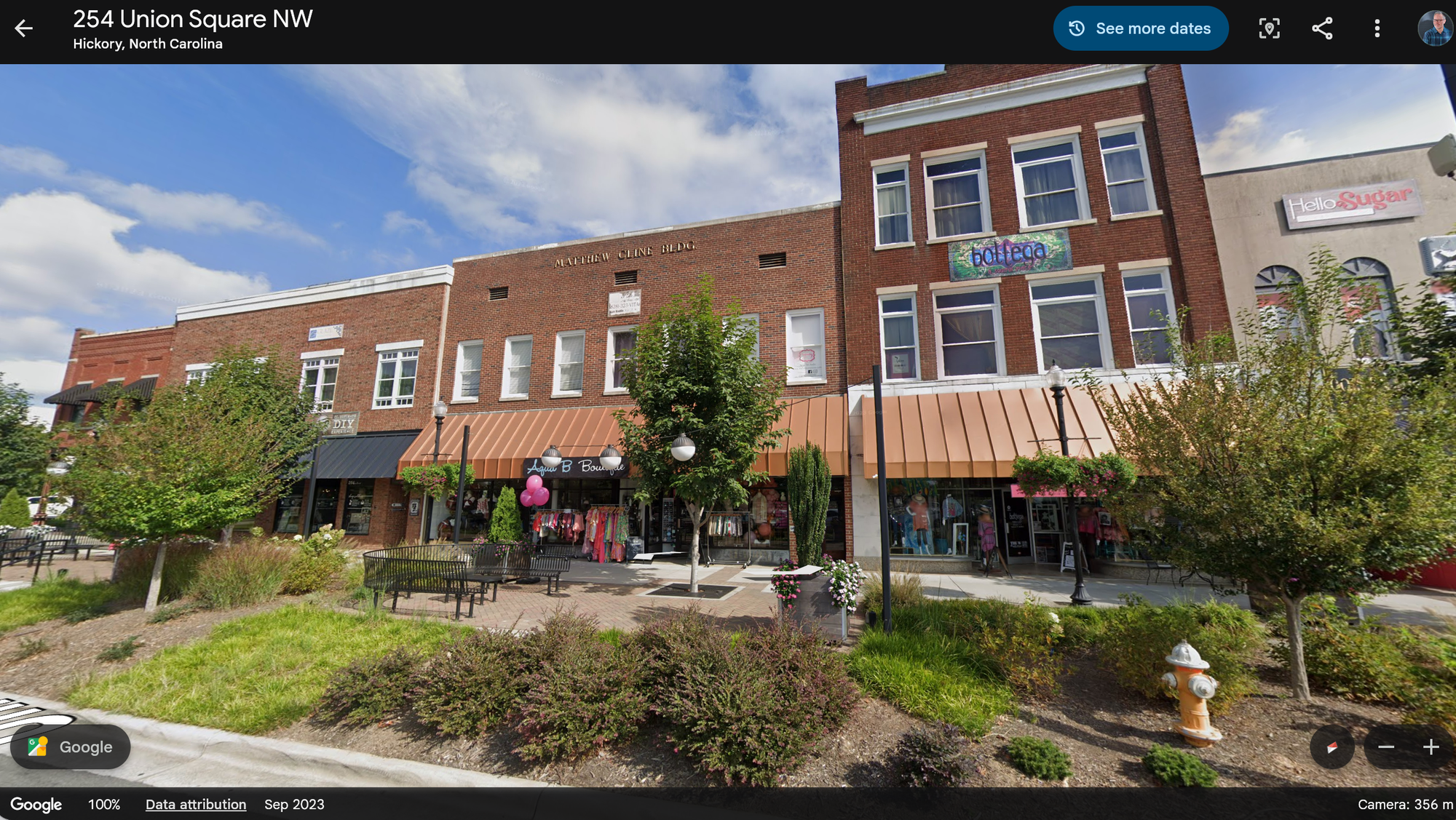
The writer also mentions downtown apartments? I had to fact check this, but sure enough, Hickory has added some density in the last few years:
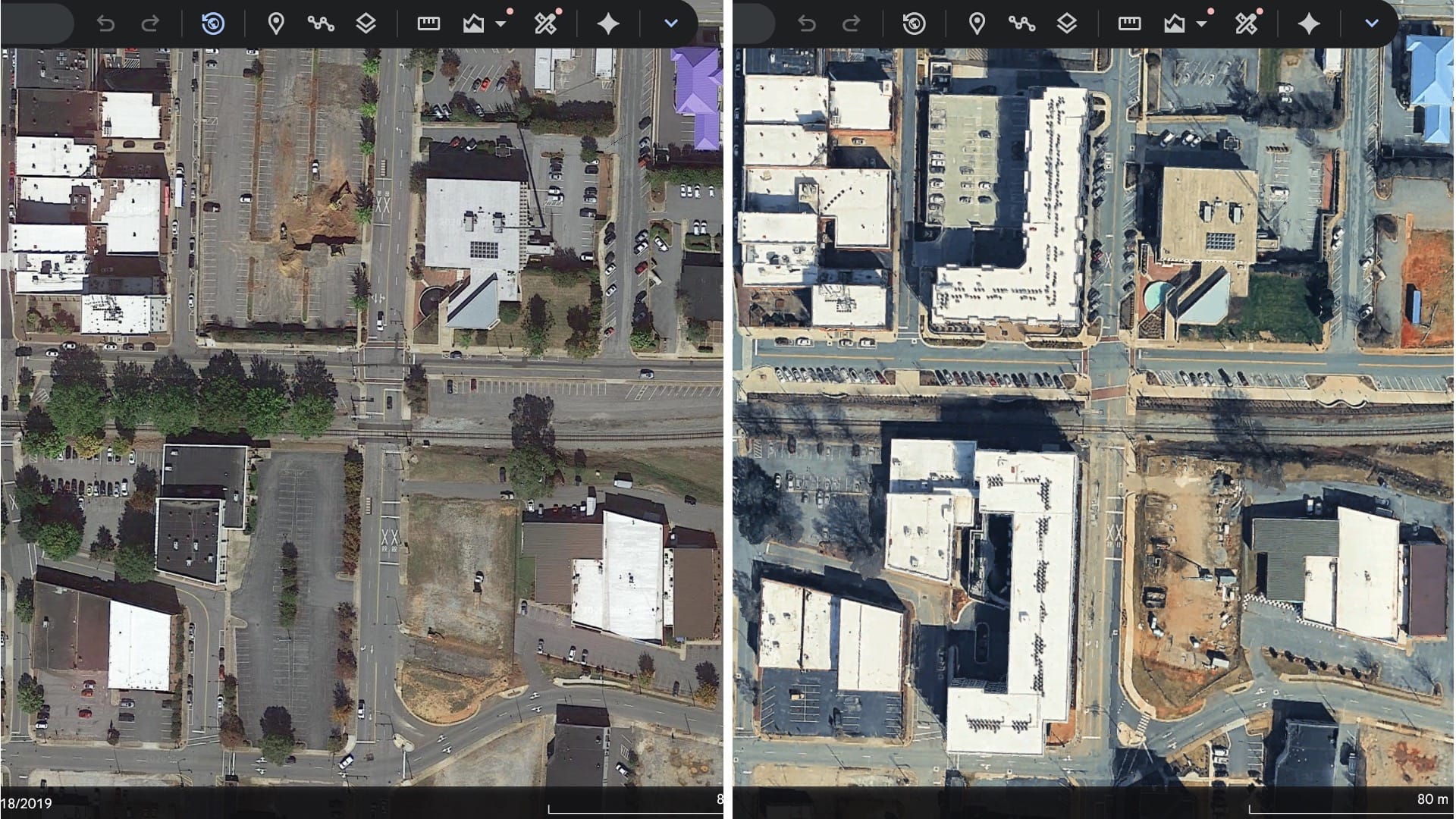
I'm not trying to be a Hickory apologist here — I'm fully on board with the writer's stance, which I'll get into in just a bit — but I think it's important to characterize Hickory fairly, since the mental picture you might get just reading the original narrative might be one of desolation and abject rural entropy.
Your downtown should not be a food desert
A couple more claims I wanted to investigate and put some data to: first, the lack of a downtown grocery store. This is a serious inhibitor to developing your city center as a viable place for less car-dependent living. Your downtown should not be a food desert. Every urban planner knows this. I guarantee the planning staff at City of Hickory know this. It's not an easy problem to solve! This was (and still is) an issue for planners and downtown boosters in Lexington, Kentucky when I visited. It was an issue in Albuquerque when I lived there, and that city has put a lot of resources into making sure the one existing downtown grocery store remains afloat as it tries to attract more residential development to the area (and the saga is ongoing).
If you live in downtown Hickory, your best bet is probably the Walmart Neighborhood Market about a mile south. Now, for some people, a mile is walkable, but let's get intimate with Hickory's transportation infrastructure. In particular, here's the intersection you have to cross if you want to get from your downtown 5-over-1 to the Walmart Neighborhood Market.
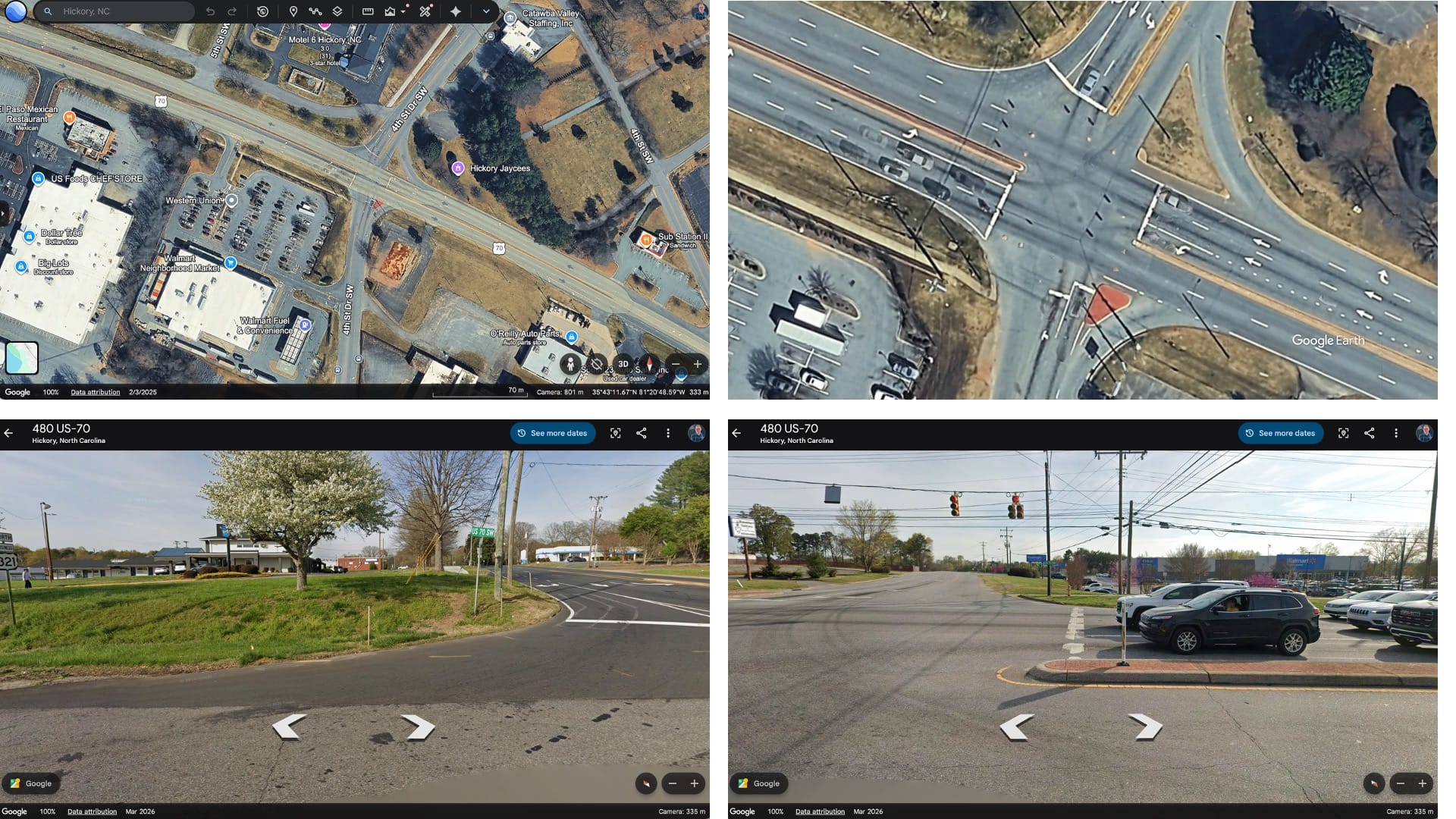
A lot of American roadway infrastructure in places like this was designed with pedestrians as an afterthought, but "afterthought" is probably being a bit generous here; it's pretty obvious walking wasn't considered before, during, or at any point after design and construction. No sidewalks, no crosswalks, certainly no pedestrian signal heads. I honestly don't even know how you begin to cross here without first double checking to make sure your estate is in order.
There is a downtown transit center, which could be convenient if you lived in one of the relatively few residential units downtown, but the I back-checked it, and the transit service is indeed precisely as dire as the writer says. All of this is to say, if you're one of the 40,000-odd residents of Hickory, North Carolina, it's pracitcally certain that you depend on a car for just about any conceivable daily want or need. In data we trust, though, so let's check the US census:
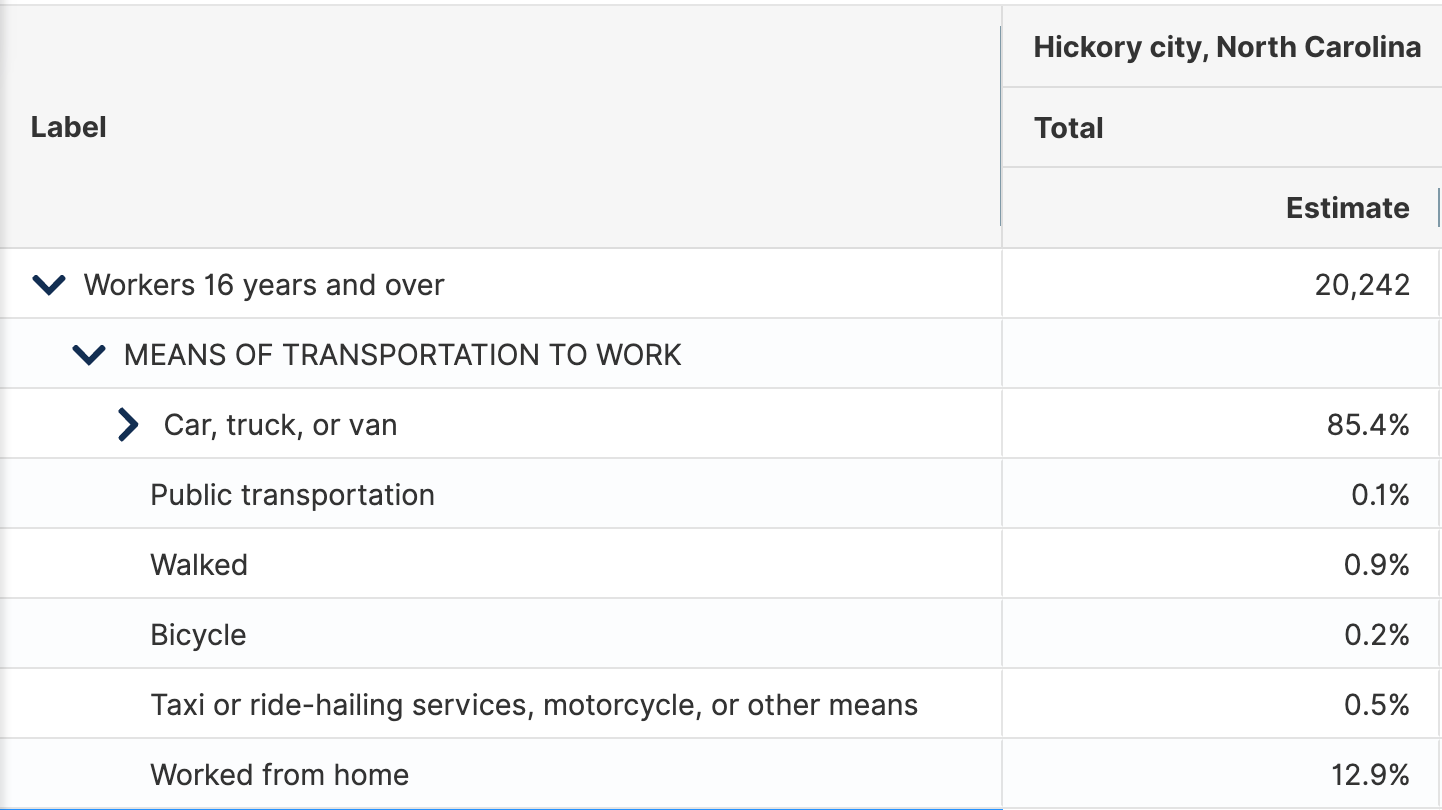
Chat, is it good if only a tenth of one percent of a city's population takes transit? Anyway, I do understand that the writer's main thrust was about the health impacts of the urban environment, but I just didn't even know how to get into it without understanding the geographic and infrastructure context.
Onward to Chicago, but first, a brief digression
Can I just say, this stuff about sedentary exurban living, and needing to wear knee braces because the lifestyle atrophies the very muscles you need for just being able to walk around, is straight out of Wall-E. I'm not saying we're irreversibly headed toward a future of morbidly obese people with useless appendages, ensconced in personal hovercraft 24/7, but sometimes it does feel that's the direction civilization is headed. I'm not even just talking about the built environment. For the vast majority of human history, our diurnal patterns necessarily included a lot of physical activity (hunting should've been plenty, but GATHERING??), yet we've rapidly found ourselves in a world where it's all too simple to work from home and order food of highly questionable nutritional value from an app, delivered to your doorstep.
What I'm saying is, living in a city isn't enough all by itself to solve your problems. You have to be a city person.You have to actually enjoy walking and being out among people.
Which brings us to the Rogers Park neighborhood. I covered Rogers Park briefly in my Chicago video last year, so I've ground truthed this, and it's possible the Walk Score even underrates it a little.
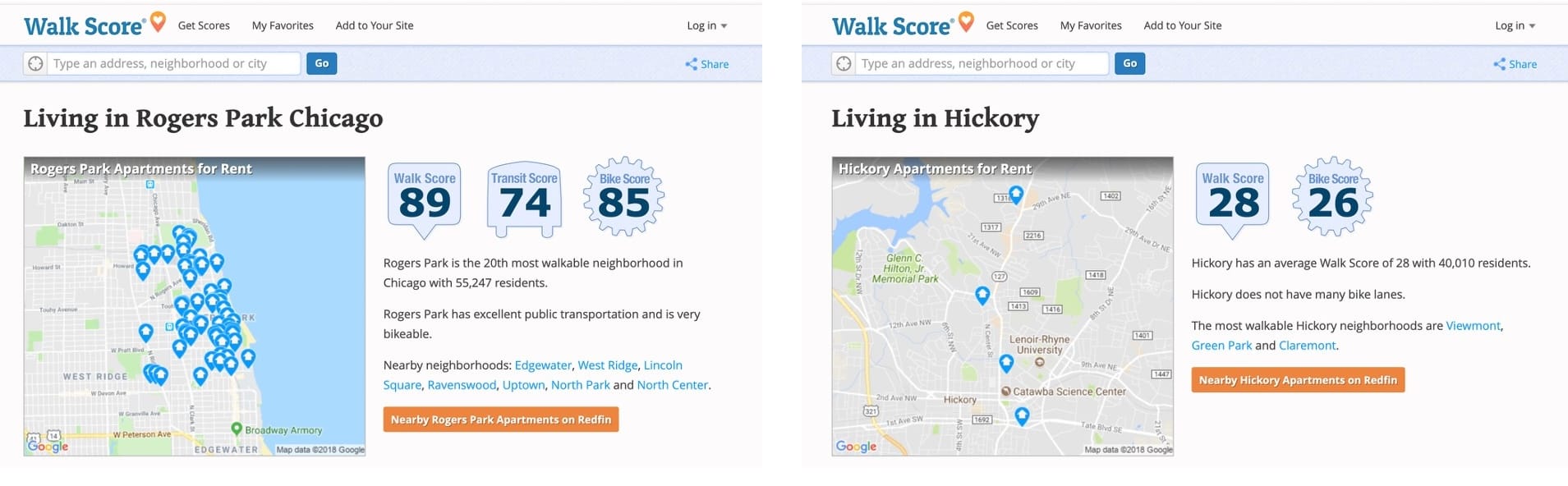
Now, the writer paints a compelling picture of the health benefits of living in a walkable place. And I do want to talk about this a little, but first a brief disclaimer. Living in a city is not magic. It will not instantly bestow on you cardiovascular fitness or socially optimal height-weight proportionality. Make no mistake, even if you do walk, bike, run, go to the gym, play basketball (he said through gritted teeth), there is no guarantee you will become svelte.
I am living proof of this. I live car free. I walk or bike just about everywhere. I go to the gym. I run a few times a week. I have a pickup basketball game I've been playing in for like 25 years. Guess what? My body mass index has been in the "overweight" range for basically my entire adult life. Part of this, I theorize, is that I'm cursed with an Irish dude "famine is always on the horizon, better store up!" metabolism, but I think more to the point...I just like to eat. I'm not even a foodie; I just enjoy calories. Anyway, this is a long way of explaining why you won't get fat shaming, or thinness as an urbanist virtue, on my YouTube channel or here in the advice column.
But health? That's another thing, so let's close with this. The fact that city dwellers live longer, healthier lives than rural and small town people is well established in the research. The causal pathways are a little less clear, but it's fair to say people who live in large cities have a significantly lower incidence of cardiovascular conditions and chronic diseases, and that the built environment has something to do with it. No doubt, we all have relatives or acquaintances who live in rural or exurban places and are experiencing health trajectories similar to those of the writer's grandparents.
Make no mistake, you CAN live in a city and still have a car dependent lifestyle. (A lot of people do!) But if you live in a place that looks like what 99% of Hickory, North Carolina looks like, you don't really have much of a choice: car dependency is really baked into it. Cities are really about having choices. And not just choices about where to eat, or get your hair cut, or send your kid to school — but the choice to get around in a more active way, the chance to change your habits, and maybe even some modicum of control over the trajectory of your health.