The Car As Dining Room

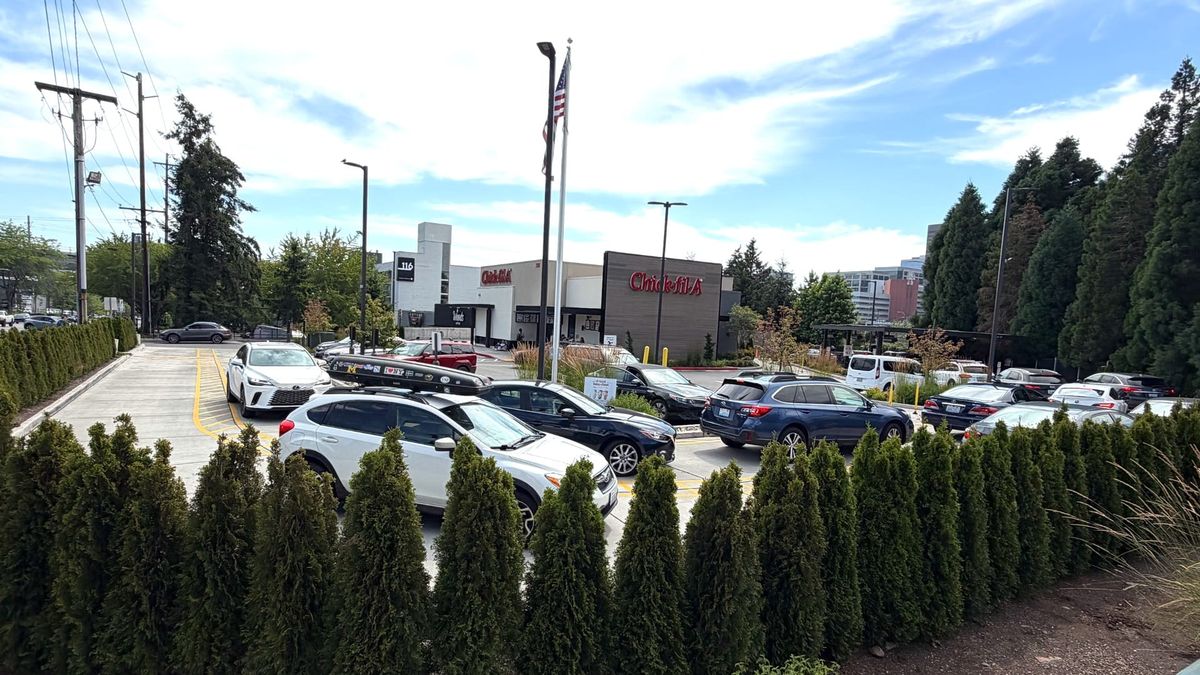
If you spend any amount of time at all in American suburbs, you can't miss it: the ongoing proliferation of ever more ingeniously designed restaurant drive-thrus. Multi-lane Chick-Fil-As and In-N-Outs. Raising Cane's and Dutch Bros. drive aisles with iPad-wielding line attendants expediting orders. You might've thought the golden age of motor dining was decades ago, when the golden arches and the Home of the Whopper ruled the car-oriented landscapes of the late twentieth century. But the data tell a much different story, possibly even a disturbing one, that goes well beyond America's omnipresent drive-thru culture.
Survey Says
Let's start with this chart from Technomic, a food service sector research and consulting firm. (Chart and accompanying article can be found here.)
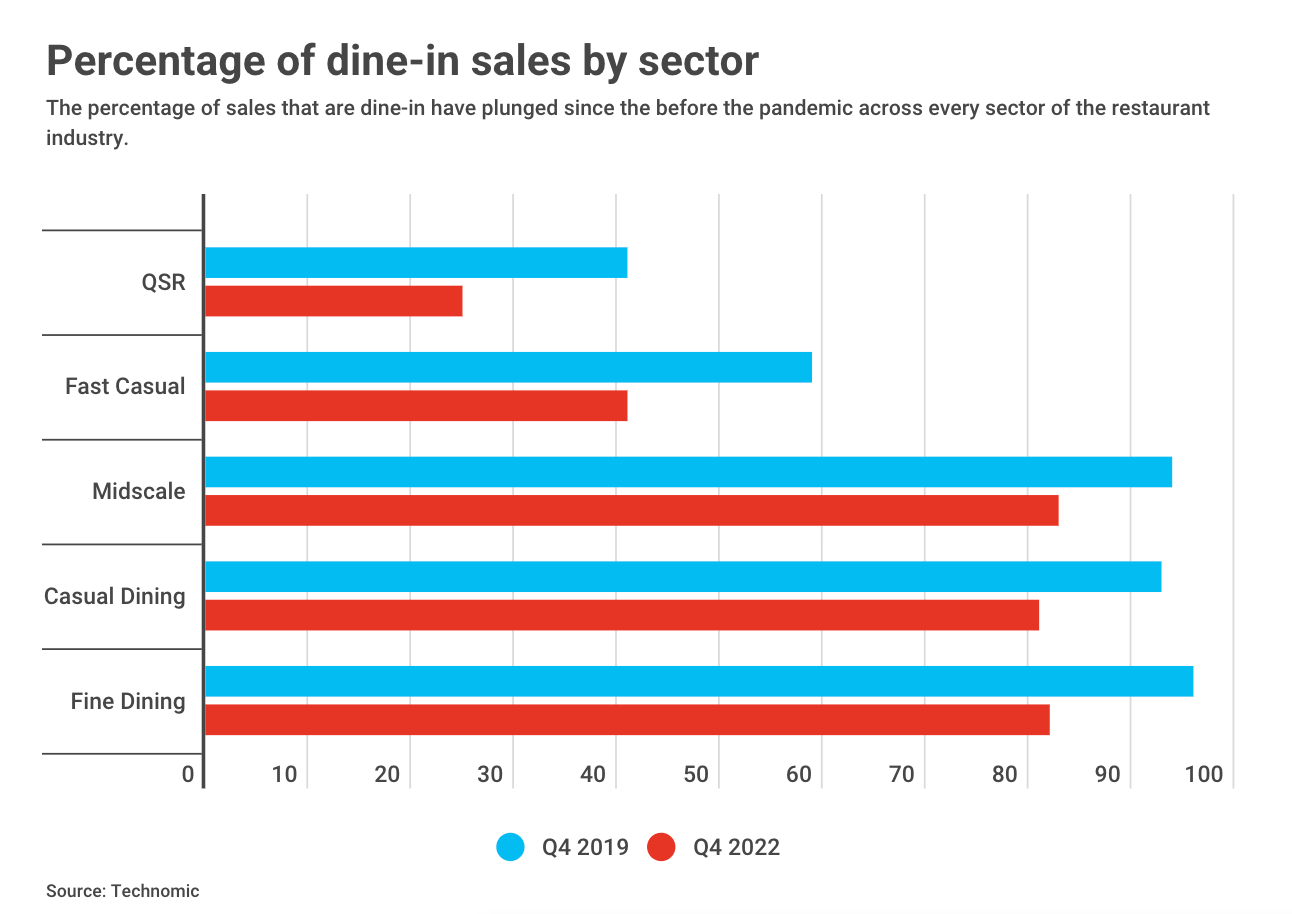
The different industry sectors are ordered from lowbrow ("Quick Service Restaurant" in restaurant biz lingo, fast food in normal human conversation) to high, but the trend is the same across the board: dine-in sales down steeply in the three or so years after the onset of the COVID-19 pandemic.
Now, charts are tricky. The trends for QSR and Fast Casual (think Chipotle or Cava) are probably the most visually striking — in fact, Fast Casual completely flipped, from 59% dine-in in 2019 to 59% takeout in 2022. But the results for the more formal dining sectors might be even more jarring when you really peel them apart and contemplate.
Fine Dining (think literal white tablecloth) is probably the most interesting example. In pre-pandemic times, just four percent of food orders were for takeout. Mind you, even four percent still feels insanely high. So much of what you pay for in a nice restaurant is a high-skill kitchen that prepares a dish with high precision, plates the results in a visually pleasing way, staff that run dishes to your table at the precise moment of ideal temperature and peak freshness. Why bother with any of that if all the food is getting dumped into a to-go box that's going to slide around in your car, lose temperature, and wilt? Yet, three years later, the takeout number for Fine Dining stands at 18%, more that four times the pre-pandemic level.
It gets even more interesting, and mildly disturbing, when you peel the data apart further, because it turns out not all takeout orders make it all the way home. Yes, people eat gourmet meals WHILE PARKED IN THEIR CAR, presumably some of them in the parking lot of said fine dining establishment. Pre-pandemic, this number was under one percent of all customer orders (although, just being real, anything above zero seems insane). But the number in the fourth quarter of 2022? Eight percent.
Are people insane?
Think about it. Restaurateurs invest enormous amounts in elevating the dining experience, in making sure every detail is right. Yet today, 18 out of 100 orders get consumed not in the luxe surroundings of a well-appointed dining room, but off site. Not at the restaurant itself, where little expense has been spared on interior design, furniture, decor, lighting, and acoustics — not to mention the dinnerware which is almost certainly nicer than whatever you use at home — but elsewhere entirely. Some of those meals get taken home, but a full eight out of one hundred get consumed...in a car.
Now, I don't drive much anymore, but when I do rent a car to head out to, say, the Oregon Coast, I'm certainly not above arraying some snacks on the center console and munching finger food as I drive. But I absolutely can't wrap my head around the mechanics of eating a multi-course fine dining meal in the front seat of a car. Never mind that this kind of dinner is usually coursed out by attentive waitstaff; the entrée alone is often a knife-and-fork effort that requires some elbow room and a level surface. Handheld items like sandwiches and burritos? Sure, that can be car food, but I'm guessing this is not what you're ordering at El Gaucho (or if you are, you should probably have your El Gaucho privileges revoked).
It's getting worse, but why?
Let's zoom back out to the wider phenomenon. A 2026 survey measured the continued rise of this phenomenon and found that, on average, Americans eat meals in their car about three times a week. One theory, already hinted at, is that the COVID-19 pandemic was a shock to consumer habits, people became accustomed to taking away instead of dining in, and they have now imprinted new behaviors that persist stubbornly.
Here's another theory: the staggering number of "food influencers" whose TikToks and reels consist of them eating in their car, holding the food up to a dash-mounted camera, and telling you what an amazing culinary experience they're having. You guys, be so for real. The reason so many influencers make content from behind a steering wheel isn't because it's even a remotely convenient place to eat food; it's because a car is like a mobile recording studio that's relatively soundproof, where you won't be interrupted, and where you can park at the precise angle that gets you the best possible natural light. (Also, and this is just my theory, but posting from your car signifies authenticity and relatability — you know, because real, salt-of-the-earth Americans are stuck behind the wheel of their car 24/7.) I think there's something to this, but it's a bit of a depressing theory in that it almost requires you to see people as uncritical dunces who reflexively mimic whatever human-like behavior they most recently observed on their phone. I try to take a bit more of a charitable view of humanity.
One thing you'll see in the restaurant industry survey work is this: people feel stretched thin by the demands of life in 2026. Whatever abbreviated time they have to eat exists only in precious, narrow gaps between the various calendar items that clutter their atrociously over-scheduled days. Eating in your car is just being efficient.
But I think it all goes even deeper. There's not only a time dimension to car-as-dining room phenomenon; there's a space dimension as well. The temporary closure of indoor dining wasn't the only way COVID-19 disrupted our eating habits. The pandemic also accelerated the erosion of the boundary between work and home, to the point where people now value time alone in their car as a way to decompress, be alone with their thoughts, and simply be away from other people, (who, to be fair, can be very annoying). In a way, the personal automobile has become a perversion of the idea of the Third Place. Yes, it's a place that isn't home (Place One) and isn't work (Place Two), but Ray Oldenburg's idea was centered around informal conversation, social interaction, and being in community with your neighbors, things he thought were foundational to democracy itself.
Eating alone in your car is the opposite of all those things. I won't go as far as to call it anti-democratic behavior, but it's definitely antisocial. We already live in a world where we're being funneled toward using our phones to order everything and avoiding human contact as much as practicable. So here's a thought: consider the act of going out to eat in a restaurant, of interacting with bartenders and baristas and waitstaff — even other customers! — as radical, as an act of defiance. Believe me, I don't have any desire to live in a world where not eating in your car is a revolutionary act. I just want to occasionally eat food that's better than what I can make at home, and do it in a space with the kind of lighting and ambient noise that absolutely ruins TikToks.
Preferably within walking distance.