Ask a City Nerd #3: Commuter Rail, Boomer Walkability, and...CityVisit Halifax?


Welcome to Ask a City Nerd. Got a question you want answered? Or a story I can use as a jumping-off point for lengthy digressions on things I wanted to talk about in the first place? Submit it here! Submissions are lightly edited for anonymity and conciseness.
This week I'm doing a couple quick hits, just as a show of appreciation to those of you who keep it short and to the point. No question (or city) is too small!
What's stopping TriMet and C-TRAN from running a commuter rail between Vancouver, WA and Portland?
I think the real answer at this point, at least for TriMet, is this: they don't want to cannibalize the rationale, or burn the political capital, for including a Yellow Line MAX extension into downtown Vancouver as part of the Interstate Bridge Replacement (IBR) project. But also, like practically every planning idea under the sun that you can possibly think of: it's been studied.
Studied recently? Not really. Commuter rail between Clark County and Portland Union Station was "considered" (visualize me making air quotes) in the lead-up to the environmental process for the I-5 Columbia River Crossing project (now re-branded as the IBR). And by "considered" I mean in the sense of putting out a request for proposals that basically asks, "Can you, the consultant, do the least labor intensive possible study that will allow us to credibly avoid including commuter rail in any of the alternatives to be analyzed in the formal EIS process?"
Actually, I'm pretty confident the RFP didn't word the question in precisely that way. Nevertheless, the answer to that question is contained in the "Commuter Rail Feasibility Study" from — I'm not even kidding about this — May of 1999. This is, as far as I can tell, the last time there was even a modicum of analytical horsepower spent exploring the issue. Actually, "modicum" is probably being generous: it's a 30-page report, which, once you strip out the front matter, the executive summary, and the footnotes, means it's roughly three paragraphs.
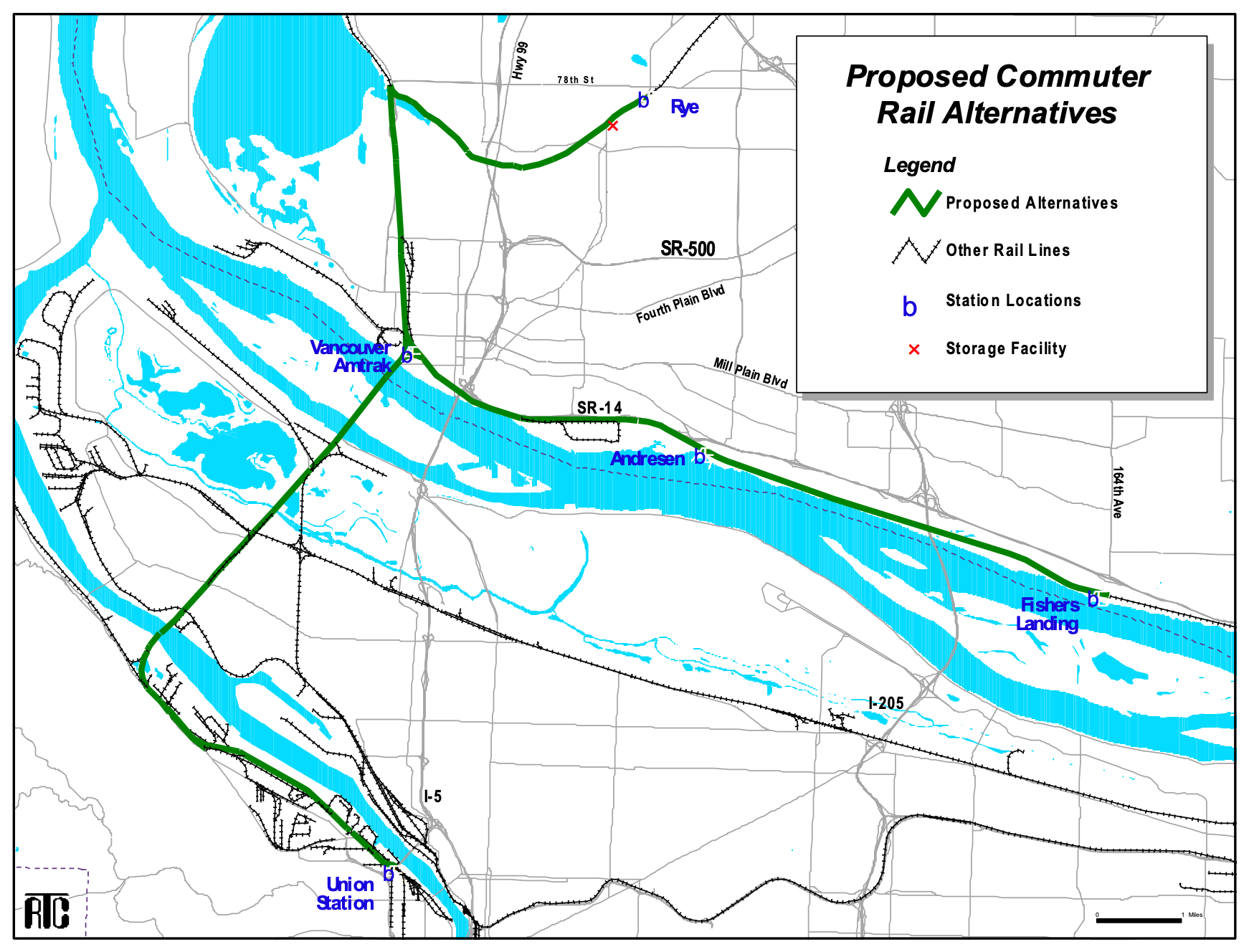
Anyway, they tested three different service levels on a network that includes two branches that converge on the existing Vancouver Amtrak station:
And here are the service level alternatives they evaluated:
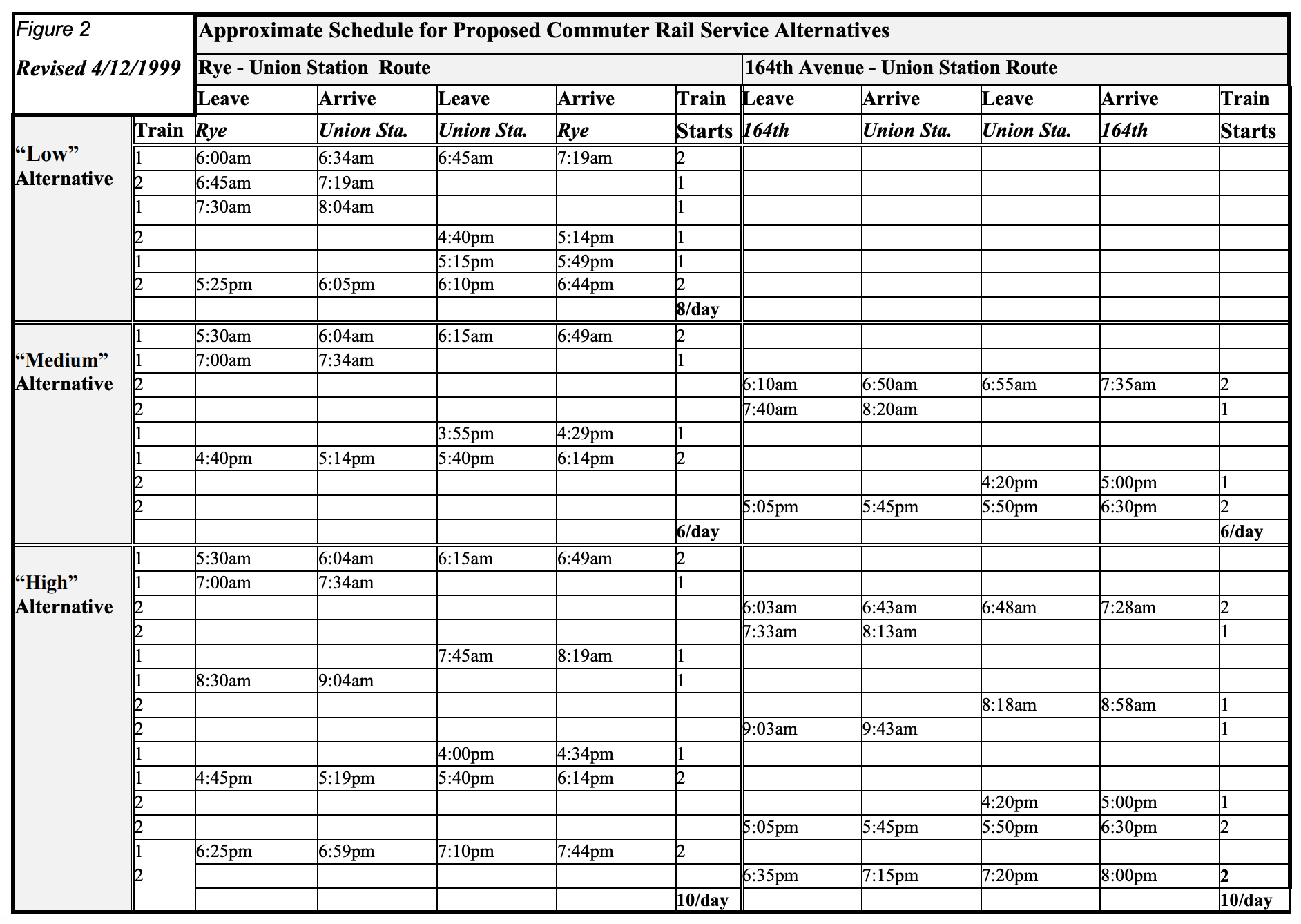
And here are the key findings. First, given existing and projected freight and Amtrak volume and demand on the network, there isn't capacity to accommodate even the anemic proposed schedule of the "Low" alternative. You simply couldn't operate a commuter service reliably given the shared infrastructure, and beyond that it, would add to the existing delays that both freight and Amtrak (Cascades, Coast Starlight, AND Empire Builder) already experience.
Then, given these constraints, you'd need a dedicated passenger rail alignment that avoids the numerous entrance and exit point conflicts on the BNSF corridor, which necessarily means lots of grade separation. Not cheap. The consultant estimated the cost of a dedicated alignment at $430 million to $750 million in 1999, which, adjusting for (1) 2026 dollars, (2) the rise in materials prices and labor costs, and (3) our nation's general inability to build infrastructure at a cost on par with any other developed nation, probably translates to like 12 trillion dollars today.
So, yes, I'm skeptical of how earnestly the commuter rail question has been studied. But, on the other hand, the Portland region's one experiment with the mode, the Westside Express Service connecting Beaverton and Wilsonville, is currently averaging about 500 boardings a day. So it's not hard to understand why TriMet (and C-Tran) wouldn't want to burn political capital — or, really, capital capital — on commuter rail when a MAX extension into Vancouver seems about as politically feasible as it's ever been.
(Also...ask me for Frog Ferry takes next time.)
How do you feel about places that are dense enough to have locations 15-30 minute walks away but without good walking infrastructure? New Jersey is full of these places where I often see people walking on the sides of highways or stroads, and I have many friends that walk only a short distance to a bus stop or train station, but their walk seems quite dangerous.
How do I feel about places that should obviously be walkable but aren't? I think those places are bad.
People ask me sometimes if there was a single moment that radicalized me, basically if there's a City Nerd origin story. And the answer is no. What I have is really an accretion of relatively minor irritations and inconveniences that somehow all managed to stick in my craw nonetheless and make me the insufferable human I am today. One such instance is a time when I traveled to Downers Grove, Illinois for a friend's wedding when I was in my early 20s.
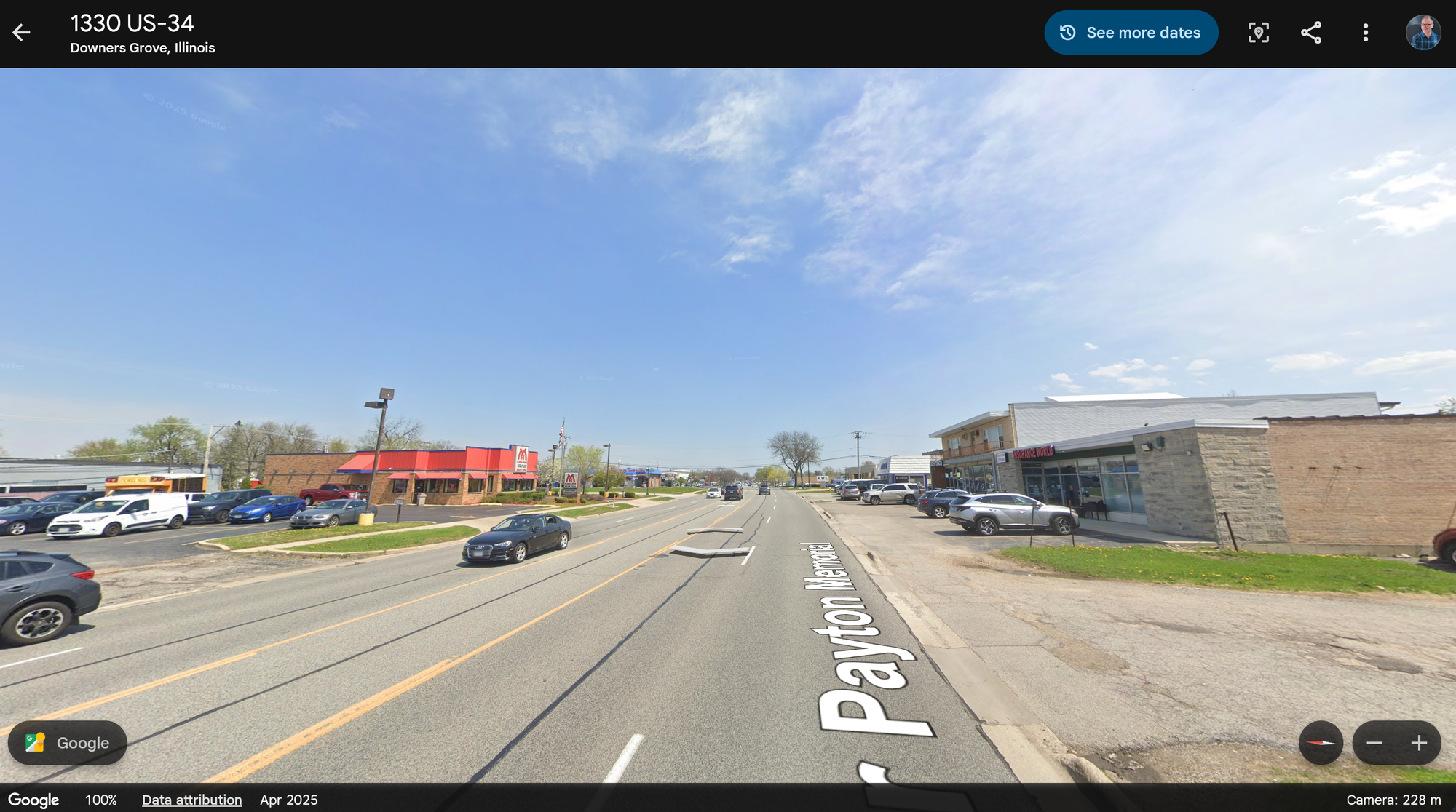
Now, I have always, always, ALWAYS loved exploring urban environments, and I wasn't about to let Downers Grove be an exception. But I was blissfully ignorant: I thought, Downers Grove is basically Chicago, right? I think I walked a few miles along Ogden Avenue into neighboring Lisle, looking for cool record stores and book stores, or other signs of urban life. It was everything the writer says about New Jersey, but likely worse. (Actually I did find a cool record store.) Anyway, the next question is related, so let's keep it moving.
Given their supposed political clout and large Boomer bank accounts, why are U.S. seniors so poorly served by infrastructure? As a health care worker, I can tell you so many stories of people literally killed or having life-altering injuries with private vehicles or housing that does not meet physical or social needs. Just sayin'.
First of all, our nation is living proof that there's little correlation between a society's wealth and the quality of its infrastructure. It's all about priorities, and within the lifetime of pretty much all boomers, the priorities in this country have been to spend roughly 1% of all transportation spending on walking infrastructure.
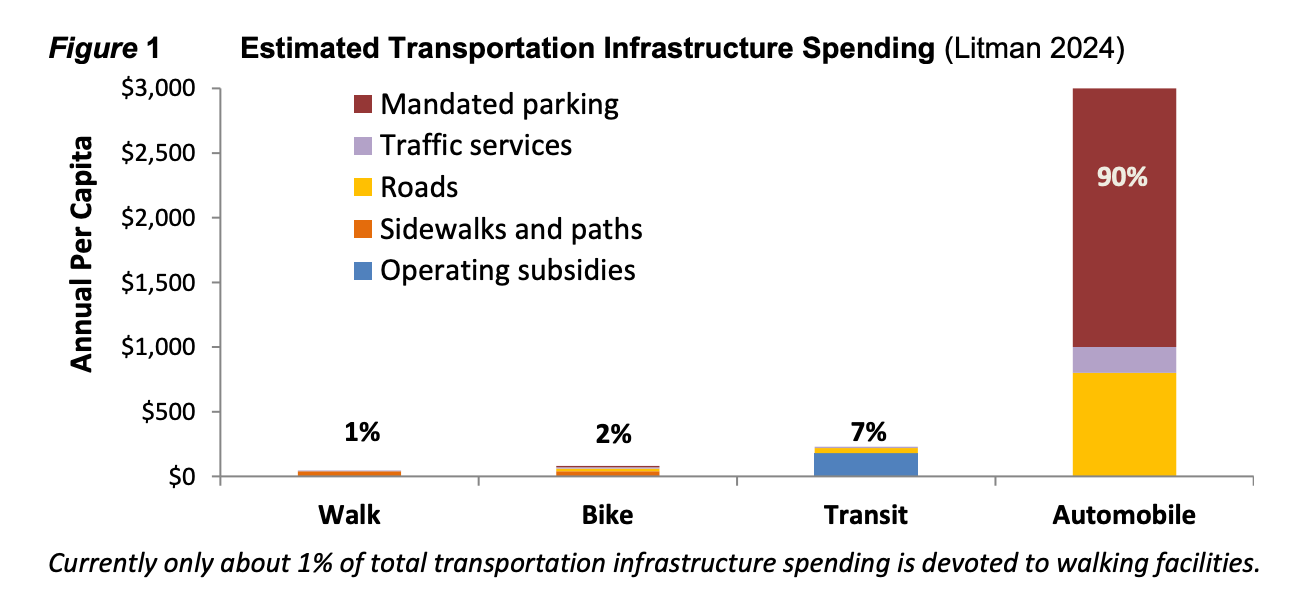
(Side note: if you want to go down a serious rabbit hole and emerge hours — or potentially years — later with a seething, white-hot rage at the sheer, self-inflicted imbecility of our car-dependent society, spend some time browsing Todd Litman's Victoria Transport Policy Institute site.)
I think this question is really about the concept of "aging in place," though. Aging in place is the idea that people should be able to remain reasonably active in their later (and hopefully retired) years, within the same communities that they were able to function as a productive adult human. It's basically that you shouldn't have to move to a "retirement community" just because your adult children correctly took the car keys away from you. You should still be able to walk to the places where you shop, eat, volunteer, play...or you can even continue working at a job, if you're truly psychotic.
And aging in place isn't just about reducing exposure to traffic violence, which the writer mentions. It's a much broader concept that touches on housing choice, social services, health care, and more, but because of my particular lens, I tend to focus on the urban planning and infrastructure aspects. And aging in place has a lot to say here: it says that older populations benefit from being able to downsize to more compact housing options that are more manageable as their mobility declines; they benefit socially and economically from living among mixed-age populations rather than being shuffled off to retirement communities; and they benefit from walkable, rollable, people-centered street designs, and transit options, so they can actively engage in community without driving.
In other words, urbanism is for everyone — especially boomers. Just sayin'.
Any plans to visit Halifax, Nova Scotia? You’ll rip us to shreds and we will deserve it. Our bike infrastructure is improving but our transit is substandard. Please visit and shame us into action.
I doubt I'd go with the "ripping to shreds" metaphor when it comes to Halifax. Rather, I imagine I'd be super interested in exploring the ferry system, which is the one thing that's ever managed to land the city on one of my top ten lists:
Yet another criminally under-viewed video
So, to answer the question, no immediate plans, but I'm intrigued, and if there's an advocacy org that wants to reach out, I'm happy to discuss! (This goes for basically every city on the planet.)