Transportation and Moore's Law


Tech skepticism is ascendant, and it's everywhere. You can see its tendrils in things like the data center rebellion that fueled a lot of 2026 political campaigns, trepidation around AI, society-wide fatigue with enshittification, and a vague desire to fire certain tech oligarchs directly into the sun.
But let's be a bit contrarian for a second. The development of the semiconductor and, in the mid-20th century, the integrated circuit, have been an almost unqualified boon to civilization. The device I carry in my pocket has a couple million times the data processing capability of the Apollo Guidance Computer that helped land astronauts on the moon. We've sequenced the entire human genome. You can 3D print your own Warhammer miniatures. Burritos can and will be delivered to your door with a minimal number of keystrokes.
We can do things today that would have seemed miraculous even a couple decades ago, let alone the 1950s. Nearly every aspect of life has gotten faster, more efficient, more convenient. Technology has revolutionized nearly every tangible aspect of human life, except one: transportation. I don't just mean that transit technologies like underground metro systems haven't been substantially improved upon in over a hundred years. I'm really talking about traffic. Motor vehicle congestion bedevils cities all over the world, and it's a problem that, for the most part, has gotten worse over time, not better.
We're going to dig into why this is — why traffic congestion is a categorically different problem and so resistant to technological fixes — but first let's ground ourselves in the thing we're actually talking about. And that's Moore's Law.
Moore's Law: a Refresher
The simple version of Moore's Law is, the amount of computing power you can buy for a dollar doubles every two years. This idea dates from 1975, and has largely been true for decades. We're now about 25 two-year increments out from that original observation, and if you want to pause reading, get out a chessboard and a sack of rice grains, and spend some time convincing yourself how powerful this concept is, I'll see you back here in a year or so.
Moore's Law is central to the conundrum we're tackling today, which is: why has transportation seemingly gotten worse while all of our other technologies have gotten exponentially better? So let's unpack it a bit. The observation by Gordon Moore, a semiconductor industry executive, actually dates form 1965, when he observed an annual doubling in the number of components in an integrated circuit, and ten years later he revised the doubling rate to a more conservative biennial rate. The revised Moore's Law has largely held true for most of the time any of us has been alive, although we've likely entered a new regime where the miniaturization of components has run up against atomic limits and difficulty of economic scaling. Still, the technological revolutions we've all seen over our lifetimes reflect this idea, and yet the question still remains: why has transportation proved immune to the exponential improvements we've seen in so many other facets of life?
To be sure, if you drive a car today, it likely carries millions of times the processing power of Deep Blue. Most of that technology seems to be marshaled to make driving itself more comfortable and less tedious, but there are relatively modern features that should at least theoretically make our roadway systems operate more efficiently: adaptive cruise control that optimizes following distance (and, you would think, vehicle throughput); safety features like lane keeping and blind spot detection that (you would hope) reduce crashes and increase system reliability; backup cameras that improve parallel parking success rate.
But to really make sense of why the exponential increase in computing capability hasn't made a dent on traffic congestion, we need to spend a bit of time in traffic engineering world, and specifically, on the idea of saturation flow rates.
Side Quest: Understanding Saturation Flow Rates
What is a saturation flow rate? It's a constant that's used in a lot of different traffic analysis applications; basically an assumption about the number of vehicles you should expect to pass a fixed point, within a particular time period, under saturated ("maxed out," if you like) traffic conditions. In the traffic engineering profession, it comes up in all kinds of policies, standards, equations and methodologies, but in the U.S., the primary place it's enshrined is in the Highway Capacity Manual (HCM) from the Transportation Research Board, originally published in 1950, and as of 2022, in its seventh edition.
The HCM expresses saturation flow rates as vehicles per hour per lane (vphpl), and specifies, in the absence of robust, location-specific field data, assumptions of 1900 vphpl for urbanized areas, and 1750 vphpl for rural. One way to conceptualize saturation flow rate is to consider the idea of "following distance" that you (hopefully) learned in your driver's education class. Aspiring drivers will often be taught a three-second rule, meaning that when driving on a highway, for example, your car should pass a fixed point no sooner than three seconds after the car in front of you. This is to account for reaction time and braking distance in the event of a sudden incident on the road ahead.
Some of you will have already jumped ahead, done the math in your head, and realized that (1) the HCM saturation flow rate assumptions are both in the neighborhood of 1800 vphpl, (2) that number can also be expressed as one vehicle every two seconds, and (3) the HCM assumes that people do not drive like they were taught in driver's ed class. This is all correct. Traffic engineering methodologies respond to empirical observations about how people actually behave, not how we wish they behaved. Individual drivers vary (ever been tailgated in the left lane?), but around two seconds per vehicle is a pretty universal average. And the geographic variations are real: rural drivers tend to be...sleepier? More conservative? (Higher proportion of slow-accelerating heavy vehicles isn't it; that's a separate adjustment in the methodology.) On the other end of the spectrum, I've heard of field studies in California urbanized areas that clocked local sat flow at 2200 vphpl. (Checks out if you've ever driven there, and now you know why a disproportionate number of the viral 20-car freeway pileup Instagram reels you see originate from SoCal.)
Now For a Left Turn
Here's common situation where saturation flow rate and all its various adjustments come into play: a protected left turn phase. Think of an intersection between two major arterials where there are dedicated left turn pockets, and the signal cycle includes a phase where vehicles in these turn pockets get a solid green arrow. That solid green arrow, for as long as the phase lasts, is a protected left. All conflicting traffic movements have a red signal. How many vehicles can the protected left turn phase serve? At the simplest level, given sat flow assumptions, about one vehicle every two seconds. Why does this matter? Well, having a good estimate of how much time you need for each phase helps you design your signal controller logic. But at the planning level, these kinds of assumptions and estimates feed into intersection capacity analysis, which, for most jurisdictions, is massively influential on future investments. Does the signal operate at a 0.95 volume/capacity ratio or better under 20-year forecast conditions? No? Well, then you probably just added a capacity (i.e., widening) project to your capital improvement plan. (Mobility standards vary by jurisdiction, of course.)
Let's bring this back to Moore's Law. Baseline saturation flow rate assumptions haven't changed in decades — but driving behavior has. It's difficult to find definitive data, but a broad survey of studies suggests that 60% to 80% of drivers use their phones while driving. There are levels to this, of course: some people literally drive with one hand while they're posting on social media with the other; some people type out a quick text while they're stopped at a red light. I'll leave alone the volumes of research on how the cognitive workload of phones and in-vehicle touchscreens has compromised people's ability to drive safely and efficiently, and just limit this to our protected left turn example.
Besides saturation flow rate, a key assumption in signalized intersection analysis is lost time. There's a certain amount of time in the signal cycle that's unused: for example, the transition between signal phases generally includes a second or more of all-red time, where no movement has a green signal. This is intended as a safety measure, to ensure the intersection is clear before the next green phase starts. (In practice, you'll see a lot of variation around the U.S. in terms of how often drivers clock this feature and abuse it by running the red at the end of a cycle.) This, as well as unutilized yellow time, is considered clearance lost time, and is typically considered to be about two seconds per phase.
But there's a second kind of lost time to consider. This is startup lost time: the seconds that are lost due to drivers reacting "late" to a signal turning green — not necessarily being distracted, but just exhibiting a very run-of-the mill human inability to stay laser-focused on a signal head for the entire duration of a cycle. This has also long been assumed to be about two seconds, and accounts for the overall inefficiency of a queue of vehicles to reach a uniform discharge rate, particularly in the first four vehicles. And it's this startup lost time assumption that Moore's Law appears to have upended, and not in a good way.
Recent research shows that the long-held two second assumption may now be seriously underestimating. There are a lot of papers out there that touch on this, but here's a fun one: "Smartphones and Traffic Signals: A Quantitative Assessment for Phone Usage Behavior on Performance of Signalized Intersections." The researchers observed driver smartphone usage and individual reaction times during queue discharge at various locations, and found that individual vehicle headways in excess of two and a half seconds were significantly correlated with whether the driver was looking at their phone while in queue.
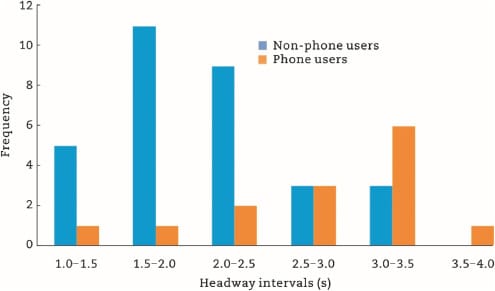
The researchers concluded that startup lost time should not be considered a fixed assumption at all, but should at this point be considered a function of, among other things, signal cycle length, as longer wait times encourage drivers to divert their attention and engage with their phones. So, next time you see an intersection capacity project in your city's capital improvement plan, well, I'm not saying it'll be because of increased lost time...but I'm not saying it won't be.
Surely Tech Billionaires Will Fix It
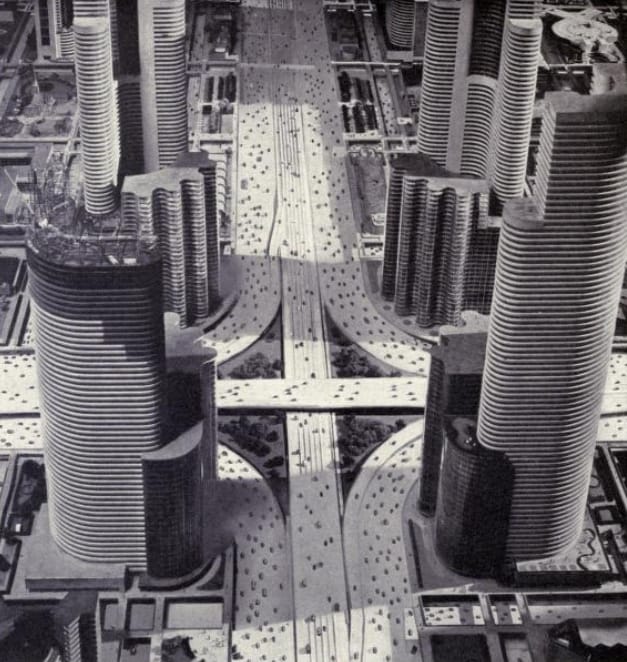
Now, it's not as if our tech overlords haven't tried to "solve" traffic with all manner of technological panaceas. You can see this today in the endless farce of tunneling schemes, Hyperloop vaporware, and flying cars that don't actually fly under any reasonable definition of the word (and regardless would require a new regulatory framework that probably won't exist in the lifetime of anyone reading this). These kinds of technical solutions are nothing new. You can see utopian engineering visions of future cities optimized for driving, just by going back and looking at photos of of old World's Fair dioramas (almost certainly funded by General Motors). The one thing all these kinds of visions have in common? They all depend on a transportation network that's wholly removed from the magnificent chaos of an urban environment. No pedestrian crossing conflicts, no bikes gumming up the works, and just...no city.
Transit consultant and all-around sharp urban thinker Jarrett Walker is fond of saying "technology never changes geometry," and I think this is basically right. Transportation exists in the physical world. There's a sense in which some physical trips can be replaced by ones and zeros (I can download a book onto my e-reader instead of making a trip to a bookstore or library), but as long as the world requires people and physical objects to be moved from place to place, vehicles will be needed to convey those people and objects, and all that movement needs to be accommodated in limited right-of-way.
(Incidentally, the best argument against Walker's maxim is probably a technology that's a couple hundred years old: high capacity carriages on steel wheels rolling on steel rails, which minimizes rolling resistance and yields massive gains in energy efficiency. Granted, none of this "changes" geometry, but it sure makes better use of it.)
So What Can Technology Change?
In the 40 or so years that you went from having a home computer with 16 KB of RAM to having a device in your pocket that has 12 GB of RAM — a difference of about a millionfold — the change in vehicle saturation flow rate assumptions between the Highway Capacity Manual's third edition (1985) and the current edition (2022) is, basically, undetectable. The observed characteristics of our vehicles and the people operating them have been, in just about every meaningful way, fixed for decades. Modestly improved accelerating and braking characteristics tend to get canceled out by things like consumer preference for bigger and heavier vehicles and increased driver inattention. (The size trend is especially galling, given that the gist of Moore's Law is that systems become faster and more efficient as components become smaller.)
One argument you could make is, a city's transportation system is just categorically different from an integrated circuit. Computing is built on logic and optimization and elegant code; our roadway system has to account for human drivers who have competing objectives, wildly varying driving skill, and often are only half paying attention to what they're doing.
The traffic engineering profession tries to analyze these things rationally. In travel demand modeling, you run successive iterations of the traffic assignment step until your outputs meet some sort of convergence criteria. Broadly, there are two types of convergence criteria: user equilibrium (UE), where each driver chooses the path that minimizes their travel time, and no individual driver can shorten their trip by unilaterally switching paths; and system optimal (SO), which aims to minimize total system travel time across all trips collectively. These convergence criteria often result in significantly different results, since under UE, individual travelers ignore the delay externalities they're imposing on all other drivers, where under SO, those externalities are accounted for. One of these types of criteria is used widely in modeling because it reflects real world conditions, and one is not. I'll let you guess which is which.
I bring this up because the only technological revolution I can really see for our urban roadway networks is under a system optimality regime. In some ways, congestion pricing gets at this, but what I really mean here is...networked fleets of autonomous vehicles whose usage and paths can be optimized by a central logic. Will it ever happen? Do we even want it to happen? I think about the billions of dollars spent on auto advertising each year, and how much of that advertising is thematically organized around human freedom and the idea that driving is "fun." These concepts — liberty and enjoyment — are antithetical to any kind of AV revolution. And sure, those ads are the brainchildren of highly compensated advertising firms, but I can assure you that, when I occasionally use a ride-hail and end up in a conversation with the driver (which I tend to avoid, but sometimes I can't resist probing the psychology of ride-hail drivers), they will tell me that part of the reason they do what they do is because they "like driving." I don't understand it, but I believe them.
So, instead of having a fleet of robot cars on a system-optimized network, we get highly fallible humans and various driver assists like lane keeping and blind spot warning indicators. It's a bit like automated ball-strike technology for home plate umpires in baseball — after you've seen ABS overturn an umpire's clearly erroneous call for the fifth time in a game, you start to wonder why we even have human umpires at all. And I think the answer is, humans (or at least the umpires' union) would revolt. We want to be in charge. We aren't ready to give up control of our vehicles — even as our devices, increasingly, control our attention.