The Education of a Toy Store Elf


City life, model trains, and muddling through to adulthood in Seattle's Pioneer Square
Here's how the interview went.
The four of us sat on the hardwood floor of a second story office just above Magic Mouse Toys, a shop on First and Yesler in Seattle's historic Pioneer Square. The attendees:
- 23 year-old me
- The middle-aged married couple who I presumed to be the toy store's owners
- A large toy stuffed animal gorilla whom the couple tried repeatedly to persuade me was the actual store owner. (This charade went on for my whole six-year tenure at the store, and I never did quite figure it out. Was it just overplayed whimsy? A legal incorporation shell game of some sort? Garden variety psychosis? Unclear.)
It was my first time interviewing for any kind of retail job, so I had no frame of reference, but I was pretty sure the interview questions were...nonstandard. Here were the important ones:
- "Spell the word 'phenomenon.'" The key here, it turned out, was to stare off into space while you spelled the word, as this was apparently an indication of high intelligence, while using your index finger to spell out the word on your splayed hand was a sure sign of abject idiocy.
- "Tell us about the last book you read." I made the mistake of giving an honest answer, which was Robert M. Pirsig's Zen and the Art of Motorcycle Maintenance, because it was the 1990s, I was in my early twenties, and I was very locked in on some hippie self-actualization crap. It also turned out to be a book the couple was a bit too familiar with. This led to more in-depth questioning than I was hoping for, including a bit too much probing around my understanding of the author's notion of "Quality," which has a very specific philosophical meaning in the context of the book. I rallied, though, and managed to deliver a substantial enough answer to assure them I'd actually read the book and was not a compulsive liar.
- "What was your favorite toy growing up?" Reminder here that I was applying for a toy store job, so this was probably one I wanted to make a good impression on. In retrospect, I probably could have manufactured an impressively obscure answer, but I opted to go with the true one: Legos. Immediately sensing they were crestfallen by how hopelessly basic my answer was, I tried to argue the point. Legos had been an incredible creative outlet, a gateway into exploring architecture and structural engineering concepts! They're weren't impressed.
Still, I'd done enough. They were impressed at the college GPA and honors I listed on my resume. They were even impressed that I'd begun university as a Civil Engineering major, even though I'd later switched to English Literature. (Still, the husband intermittently referred to me as a "failed engineer" for the next six years, which was both true and less amusing than he seemed to think it was.) They prided themselves on only hiring "A students," although to this day it's unclear why a high GPA and a college diploma were required to sell beanie babies and Goosebumps books. They even specified that I should bring my diploma to the interview, and yes, they spent a good minute eyeing it and reviewing for authenticity. But, I was in. And the job title?
Elf.
Magic Mouse Toys closed abruptly in early August 2026 after nearly 50 years in business. Several local news outlets covered the store's shuttering, all of them pointing out that no reason was given for the closure. At time of writing, the shop's expansive display windows are papered over. The future of the space, in the Mutual Life Building, on a prime corner in the heart of the city's premier historic district, is unclear.
The store owners quickly realized that while, yes, I was a failed engineer, I was still good with numbers, and I had a knack for analytical problem-solving. This quickly led to me being put in charge of reconciling the receipts each night at closing, and making deposits at the Key Bank branch half a block down First Avenue South. Soon enough I was charged with scheduling staff shifts, which, particularly in the nutso holiday season, was a five-star logic puzzle of competing objectives like (1) variable customer traffic that peaked on weekends, (2) trying to give elves two off-days in a row as much as possible, and, of course, (3) rigging the schedule so I myself could spend the minimum possible number of hours working with the most irritating coworkers.
This last criterion was probably the toughest to satisfy, given the type of people who are both smart enough to make honor roll in college and, also, unable to land a job offer better than toy store elf. (Yes, I realize I too was in this category.) Presumably, all of these people had passed the stuffed gorilla interview phase and were able to spell words without writing on their hand like imbeciles. Beyond this, I'm not sure what the owners had in mind as ideal employee characteristics when they made hiring decisions, but given the collection of elves I worked with over six years, qualifications apparently included:
- A degree from a small liberal arts school that they absolutely couldn't shut up about
- Having fucking terrible taste in music, like asking me if I've heard the new Barenaked Ladies or Crash Test Dummies record, or telling me in all seriousness that Tori Amos' version of “Smells Like Teen Spirit” is better than Nirvana's because the original song is actually very stupid, you see, but she deconstructs it and adds layers of previously unexplored vulnerability and emotion
- Having studied abroad in like Amsterdam or Bologna and not being able to shut up about that, either
- Being recently relocated from a smaller city in the Midwest but, amazingly, also immediately being an expert source of insight on Seattle and Pacific Northwest culture in general
- Going into the Starbucks outlet across the street and passing a long handwritten note to one of the baristas with suggested improvements to the shop's limited menu of light lunch items, and could the barista please elevate these recommendations to whoever is in charge around here
This is just to give you an idea of the personnel I was working with. Pretty grating at the time, but in hindsight, roughly what you would expect. It seemed every elf was some combination of aspiring filmmaker, artist, actor, writer, or musician (I was three of these, guess which) — in other words, mostly people for whom all of this would be just an unfortunate waypoint on the path to conventional adulthood. Although for some, it went even deeper: the ignominy of elfdom was an inciting incident, an existential trauma that propelled them to go back to grad school and get a real fucking profession.
Later, I began to understand the toy store as, not a purgatory, because that feels a bit dramatic, but maybe as a sort of bardo, an intermediate zone for people who haven't found a bridge between their formal education and whatever is supposed to come after. It's completely understandable. There's no obvious landing spot for gifted kids who sink four years of their young life into comparative lit or art history. What awaits you in your twenties is most often a series of poorly compensated, soul-destroying service jobs — a long dark night of the soul you have to find your way through. (OK, that does end up being a bit dramatic, but I stand by it.)
This isn't intended as a "why are people taking out ruinous amounts of student debt to obtain useless liberal arts degrees" rant. I was one of those people, and I don't regret it for a second; it eventually led to an existence where I can do liberal arts stuff like making short films and telling stories and getting paid to put them on the Internet. But it took decades and a very circuitous path to get there, and I suspect prospects for young people in similar circumstances have deteriorated significantly in the succeeding years. Yes, I only made $13.50 an hour as a toy store elf, but...I was paying like $285 a month for a one-bedroom in Lower Queen Anne. "Purgatory" is probably a severe understatement of what downtown Seattle retail workers experience today.
In 1889, in the basement of a footwear store on the corner of First and Madison, a carpenter's glue pot overheated and overflowed onto a floor covered with wood chips and turpentine. A few hours later, central Seattle, whose buildings were primarily constructed from the abundant nearby timber, was burnt to the ground. The Great Seattle Fire leveled everything.
The Mutual Life Building on First and Yesler, three blocks south of Madison, is what now passes for a historic building in Seattle. Meaning: it dates from just the 1890s, a period when the city rapidly updated its building standards and fire code, and rebuilt everything bigger and better than before. (Brick was preferred this time.) This included rebuilding many of the streets up to 20 feet higher in elevation than what existed before, especially near the bottom of Yesler Way, where the steep grade had always been considered problematic. The fire was a cataclysm, but also an opportunity to remedy the city's challenging topography.
The reconstructed, newly elevated streets required high retaining walls to stabilize the roadbed and supporting fill, especially down near First Avenue. New buildings like the Mutual Life sprouted from foundations at the original ground level one story below, and vaulted sidewalks were constructed to connect the rebuilt streets to what would be ground level entrances at the new sidewalk level. Beneath the vaulted sidewalks lay empty areaways: concealed spaces, up to a story high and the width of the sidewalk, that ran between the retaining walls and the subterranean building exteriors.
Magic Mouse Toys sprawled over two levels of the Mutual Life Building: at sidewalk level, the Villa, where you might find stuffed animals, dolls, infant and toddler toys, and die-cast cars and figurines; and below grade, the Grotto, roughly 75% of the store's floor area and labyrinthine enough to have its own subspaces: a game room, a puzzle room, a book room, and a variety of nooks and alcoves where you might find construction toys, art supplies, and science kits. (Model trains as well, but we'll come back to that.)
There were also a variety of off-floor areas for storage and inventory processing, including an entire corridor outside the walls of the store, in the areaway underneath the First Avenue sidewalks, called the Quarry. So called because of the jagged and continuously disintegrating rock of the retaining walls, it was a space dimly lit by the translucent glass inlays on the First Avenue sidewalks, and retrofit by the store with shelving units and fluorescent lighting. The Quarry was essentially what you now pay thirty bucks to see as part of the official Underground Tour across the street at what was then Doc Maynard's Public House; a recurring joke among certain elves (OK, me and one other) was that when a tourist came in and asked where the Underground Tour was — which happened daily — we should pocket the thirty bucks, send them into the Quarry, and then lock the door behind them until they’re done taking inventory.
If you imagine a city's entire street grid as a Cartesian coordinate system with an x and a y axis, the intersection of First Avenue and Yesler Way is basically (0,0): the origin point of Seattle. This isn't meant to discount the millenia during which indigenous people occupied various villages around Elliott Bay, or even the very first European settlement in the Alki area of what's now West Seattle. What I mean is, not only do you feel in your bones that you're in the cradle of the city when you're at First and Yesler; it's literally the zero point of the city's entire street numbering system. Everything south of Yesler is addressed "First Avenue South," while everything north of Yesler — including the Mutual Life Building, where Magic Mouse sat right at the corner — is simply addressed "First Avenue," with no directional. Then, as you travel north on First Avenue, the numbers rise. The Mutual Life Building is 601 — there is no lower number on the west side of First Avenue — and the numbers keep increasing as you move through Downtown and Belltown until you get to Denny Way, at which point you are now in Lower Queen Anne, where the numbering resets to 100, but you are now on "First Avenue North."
If the job had a saving grace, it was the location. First and Yesler was, and is, extremely transit-accessible, primarily by the underground Pioneer Square transit station up at Third Avenue, now a Link light rail station but then a highly useful bus tunnel serving multiple King County Metro lines. No matter where I lived, the commute was easy, and during my elf tenure, I lived in rentals all over, moving after each one-year lease was up: Northgate, Ballard, Interbay, Upper Queen Anne, Lower Queen Anne. This last location was perfect for leisurely two-mile walks to work on weekday mornings. Strolling through Belltown as it was just waking up, stopping for breakfast at Pike Place Market as the vendors began to open up and the ferries blasted their horns out on Elliot Bay — all of it was like taking a mini-vacation before I had to face a day of bad music recommendations from coworkers, idiotic questions from tourists, and my own constant low-grade unease that my life was stuck in neutral, or worse, slipping away from me entirely.
(The idea that I had this kind of angst about my future when I was in my twenties, that I gave myself so little grace, all seems incredibly absurd now, given decades of hindsight. But I also don't think it's uncommon to carry the weight of self-imposed expectation at that age, so I don't beat my younger self up for it. It's a function of emerging into the adult world. For a certain type of person, it's unavoidable, and probably even more potent and damaging today, intensified as it is by technology we carry in our pockets that gives us a 24/7 window into everyone else's curated projections of success and achievement.)
The other coping mechanism that made the work day bearable was my discovery of third places, although I didn't understand them as third places yet because Ray Oldenburg's book still languished in obscurity. But I intuitively understood that a 15 or 30 minute break was an opportunity to find a place that, while physically near, was as far psychologically from the toy store I could possibly get. And Pioneer Square was full of these places. Elliott Bay Book Company for browsing (and occasionally buying, bank account permitting), before they relocated to Capitol Hill, and various indoor and outdoor public spaces, but mostly coffee shops. Places on Cherry Street or Occidental Park where I could just sit and read, and hear myself think, treasuring every State Department of Labor-mandated minute before I had to return to the retail floor.
Make no mistake, I despised this job, which, in retrospect, seems absurd: what could possibly be that objectionable about working at a toy store? Well, a variety of things, but mainly, it was the owners deciding that if I was a smart, capable person who was good with numbers, then certainly I must be a good manager. Which I can now tell you with complete confidence simply isn't true. Being "good at a lot of stuff" does not make you management material; managing people is a whole other skill set entirely. Yet, at the toy store, not to mention every agency and firm I worked at in my later professional life, management is about the only track where there's a prospect of serious career advancement. Granted, I was only getting paid an extra buck or two an hour to take on the additional responsibility, and there were no further rungs on the ladder, but...who says no to a raise when you're in your twenties?
So there was a certain amount of angst in having to train elves and give them feedback, interpersonal friction that didn't pair well with my vaguely Asperger-y demeanor, things that, absurdly, kept me awake nights dreading the next workday. But there were also day-to-day features of the job that ate away at my psychological well-being. For example, we were required to play an endless procession of children's music and books-on-tape over a sound system in the book room, a long, narrow, brick-walled space where sounds reverberated and multiplied. If you think this sounds like a minor thing, try this experiment: put Raffi's "Bananaphone" on repeat, set a timer, and see how long it takes for your psyche to become completely unglued. If you aren't familiar with "Bananaphone," it's a song about holding a banana up to your ear and pretending it's a telephone. That's really it. The chorus goes, "Ring, ring, ring, ring, ring, ring, ring, bananaphone," and however many times you think a song’s chorus could or should possibly repeat, be assured the “Bananaphone” chorus repeats many, many more times than this before the song is done. When the song is over, play it again. And again. And then call your therapist.
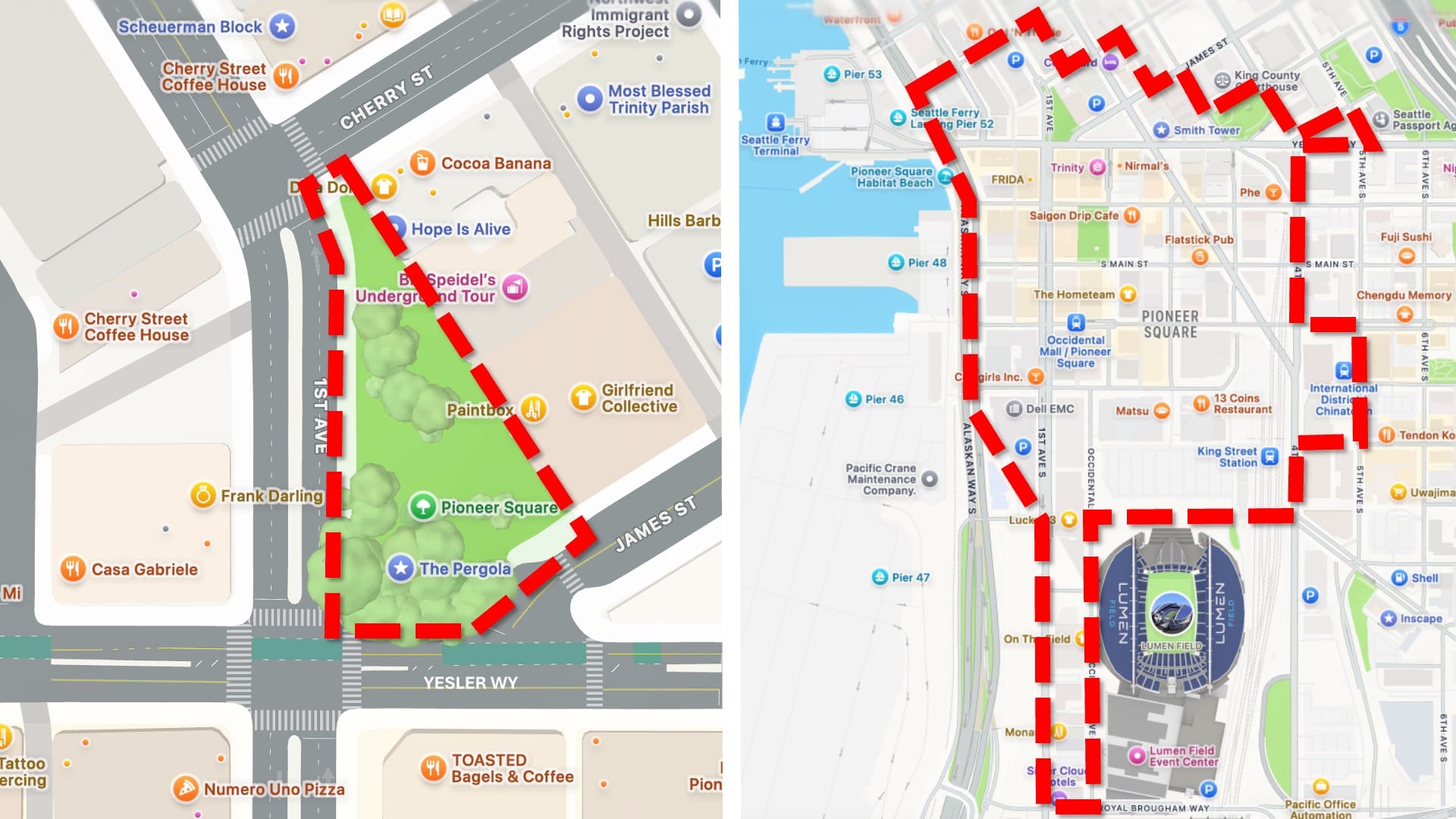
Pioneer Square can refer to a broader historic district that stretches as far east as Fifth Avenue, and far enough south to nearly touch the city's largest pro sports venue, Lumen Field. But Pioneer Square is also a city park, or really a plaza, that's enveloped by 1890s-era buildings like the Mutual Life. It's actually not a square at all but an irregular polygon bounded by First Avenue, Yesler Way, Cherry Street, and James Street, which intersects Yesler just east of First at an odd diagonal.
Why the irregularity? Well, it turns out First and Yesler isn't just the zero point on the city's coordinate system; the location isn't just the most visible example of the way the city rebuilt itself after the Great Fire; it's also where two competing ideas for the city's street grid came into conflict and, as the streets were reconstructed, had to be reconciled once and for all. Everything north of Yesler Way had been platted by Arthur Denny and Carson Boren, who preferred a street grid that ran orthogonal to the Elliott Bay shoreline. Everything south of Yesler was Doc Maynard territory, and Maynard preferred cardinal directions. The bend in First Avenue between Cherry Street and Yesler Way is an artifact of this reconciliation.
OK, so I feel like I've buried the lede here a bit. What they hired me for, the actual thing they included in the job offer, wasn't just to be an elf. It was elf-plus. I was tasked with managing the store's high-end model train department, which I had no idea existed until they made the offer. I still don't know how they clocked me as a Train Guy, it wasn't something I'd ever manifested previously as far as I know, but in hindsight, I suppose they kind of nailed it.
The store didn't sell run-of-the-mill American model train brands like Lionel, which would be unbefitting for a specialty toy store. Too mid-market. Rather, they only stocked imported German model trains: some Fleischmann and LGB and Roco (OK, the last one is Austrian, actually), but mainly Märklin. Märklin is a Göppingen-based toy company that dates back to 1859, when they initially specialized in doll house accessories, but entered the model train market around the turn of the century when they realized the two product categories shared some key attributes: miniaturization, near-infinite customizability and demand for expansion and accessory, and satisfaction of the customer's deep desire to design, build, and rule over their own little world.
Imported German trains turn out to be very expensive, and it became clear over time that the Magic Mouse owners never expected this to be a volume enterprise; rather, they seemed to love the frisson of luxury and exclusivity that being an authorized Märklin dealer conferred. (This was true of high-end imports all over the store, like Steiff mohair bears — also German — and Corolle dolls from the Loire Valley of France.) Even though it was some of the store's lowest-churn inventory, Märklin trains commanded the most valuable real estate in the Grotto: right in the basement shop windows, and in the path of interior customer traffic between the two floors.
And not just anyone could sell Märklin trains. The toy store was the only authorized dealer in the region as far as I was aware, and the owners intended to keep it that way. Maintaining that status came with a cost, though: one of the requirements was, someone from the store had to attend an annual boot camp and go through a certification process. This involved some sales training and product education, but being an authorized dealer also meant having some minimum competence to do some basic train maintenance and repairs. This included, beginning around the time I was hired, being able to retrofit the motors on existing analog locomotives with a new silicon control chip. The company had recently introduced a digital system that sent instructions to trains via a series of zeroes and ones delivered through the voltage of the track itself, and older locomotives needed to be upgraded to be compatible. This meant, once a year, I had to go to New Berlin, Wisconsin to refresh myself on how to operate a soldering iron.
New Berlin is a moribund suburb just outside Milwaukee, and also then-headquarters of Märklin USA. The trainings brought together dealers from all over North America, packed them into a two-star chain hotel, and herded them through German train propaganda Powerpoints and makeshift repair lab sessions that went until 4:00 P.M. each day. After that, we were on our own. For most people this meant a sad chain restaurant dinner at the shopping mall across the street, but for me it meant precious time and freedom to investigate an unfamiliar city.
Milwaukee was probably my first realization that I have a borderline unhealthy mania around just setting out on foot and exploring cities, letting my intuition take me wherever it will. (It's something I do several times a year now, except now I document the experience upload the results to YouTube.) Over several Märklin boot camps I became familiar with the bus route that would get me out of what I already understood as the hostile suburban design of New Berlin and into the city the fastest, and then I'd either walk myself to exhaustion exploring downtown and the central neighborhoods, or, if the Brewers were in town, I might find the game day special express that took you directly to old County Stadium.
(The game day bus was no joke. On one of my junkets, the packed bus I was on pulled into the final express stop before entering the stadium complex, and a confused rider stepped on and started asking the driver a time consuming series of transit-related questions that had absolutely nothing to do with baseball. Finally, a slightly unstable-seeming passenger near the front dressed in full Milwaukee regalia shouted out, "Get off the goddam bus, we're going to see the BREW CREW!" The poor rider disembarked, the door closed, and we sped off to the stadium. Game day is not to be messed with.)
The trips to Milwaukee were an annual highlight, but in all honesty, I was indifferent toward model trains themselves. Still am. But there turned out to be one merchandise category that inspired something other than apathy: games and puzzles. Board games, jigsaws, tabletop card games, RPGs — all of these had been fixtures throughout my life; even today I still love a good game night. Over time, I became the buyer for every line we carried, curating SKUs I knew would sell in volume, SKUs that might move slowly at first but that I wanted to put in front of people, and SKUs I simply thought were cool as hell. I wanted the store to have the best cribbage board selection, the widest variety of 5,000-piece puzzles, the finest assortment of tarot decks, anywhere in Seattle. And even though the games were all stocked in the most remote location — the deepest part of the Grotto — they became our most profitable category. I even got mild satisfaction out of running the reports at closing every night and seeing the game department's sales figures keep going up.
It ultimately got to the point, near the end of my elf tenure, where I seriously considered the possibility of opening my own game store. I did reconnaissance all over the Puget Sound region on my own time, scouting the competition, understanding the landscape. In some parallel universe, I'm a game store entrepreneur instead of a guy who talks about transit and cheesecake factories on YouTube, but in this universe, I was a seriously undercapitalized twenty-something who didn't come from any generational wealth to speak of. In retrospect, I probably dodged a bullet by choosing not to be a small business owner. So, no hard feelings, and to this day, one of my favorite things to run across when I'm exploring an urban neighborhood is a tabletop game store, which I always consider a third place par excellence.
The exterior Grotto stairwell and entrance opened out onto the northwest corner of First Avenue and Yesler Way, Seattle's x-axis, the dividing line between Denny and Boren's context-sensitive grid to the north and Maynard's brute-force cardinal one to the south. But even this undersells Yesler Way's stature among city streets. The full, formal name of the Pioneer Square neighborhood is the Pioneer Square-Skid Road Historic District, and Yesler is the skid road in question. In the late decades of the 19th century, Henry Yesler ran an operation that involved harvesting trees at the top of Seattle's First Hill and sliding the logs down the street that now bears his name, to a steam-powered logging mill at what was then Front Street, now First Avenue. The area round the mill teemed with flophouses, beer joints, and other land uses catering to the questionable wants and needs of itinerant loggers and mill workers; in other words, elements that today are synonymous with the idea of "skid row" in cities all over the English speaking world.
Before its decline, the store was often a stop for celebrities coming through town on tour, or a movie shoot, and on the hunt for properly upscale merchandise to bring home to the kids (or just for themselves; I don't ask questions). I got to help Jeff Bridges shop for musical toys. (And then I stole his signed AmEx charge slip and keep it to this day as a souvenir. I'm not sure if this is a prosecutable offense.) I sold toys to Rutger Hauer, eyeing him carefully for evidence he wasn't a product of the Tyrell Corporation. Dan Wilson, then an all-star catcher for the Mariners, now the manager, very personable dude. Courtney Love (the less said the better). Mick Jagger came in when the Stones were in town for a date at the Kingdome, which was kind of embarrassing, as the store owner, unbidden, assigned herself to be his personal shopper, was just a hair overeager, and kept attempting jokes and banter that didn't seem to be landing at all. (Speaking as someone with not even one-trillionth the celebrity of Mick Jagger, but who still gets recognized in public, my working assumption is that truly famous people prefer that you at least pretend not to recognize them, and permit them the illusion of anonymity.)
What I really enjoyed was spotting the celebrities that nobody else was likely to recognize, who might have had a reasonable expectation of not being recognized, and approaching them and just treating them like a normal customer. This worked best when I was in my natural element in the game room. It's where I sold playing card decks to John Doe from the band X, and backgammon sets to Ted Levine, most famous for (and likely unrecognizable in public from) his turn as Buffalo Bill in "Silence of the Lambs," but who I absolutely adored in Alan Rudolph's "Love At Large." (I may be the only person on the planet who remembers this movie fondly, or at all, and I'm more than fine with this.)
Near the end of my elf tenure, in the late 90s, you could squint and begin to see that the deck might be stacked against independent retailers with slightly eccentric tendencies. The store had recently invested in a new point-of-sale system that was designed to scan UPC codes and connect to an inventory database. The owners didn't want to pay the hefty license fee for the off-the-shelf database service, though, and then we never got around to building the bespoke system they seemed to think it would be trivial to build, so we continued to note sold items by hand on a clipboard and use the completed inventory sheets for restocking.
You could start to feel the world speeding up while the store sat still. In my last year as an elf, one of the new hires was a recent arrival in Seattle (most elves were). The reason for their move from the east coast? Their partner's new job at a Seattle-area tech startup that sold books over the web, shipping them to you for less than what you would pay in a brick-and-mortar store. Already the startup was gaining converts, even among elf staff. An independent specialty retailer was just never going to be able to compete with economies of scale like that. Decline was inevitable; it was just a matter of time.
Or maybe it wasn't. By any measure, 50 years is a pretty phenomenal run for a retail establishment, and in any case, the details of one particular store's closure aren't that easy to diagnose. In a way, all successful small businesses are alike, and all struggling ones struggle in their own ways. The margins are thin, and there are infinite combinations of factors that can set off a doom spiral. Specialty retail is almost certainly a tougher business today than it was in 1998, but reports of its demise are, I think, greatly exaggerated. I say this partly because, as an urbanist, I simply can't accept a world that doesn't have the street life and variety that comes with small-scale, independent specialty shops.
But also, maybe the decline of brick-and-mortar is less inevitable than we've been led to believe. After a steady contraction in the 2010s and a seeming glide path to what looked like certain insolvency, Barnes & Noble is now resurgent and adding locations. The independent book and record shops that a decade ago I thought were destined to be shuttered, are, in many more cases than I would have expected, still around, and new ones opening. Tabletop gaming is bigger than ever. It will be incredibly disorienting to see a new business move into the vacant space on the northwest corner of First and Yesler, but one almost certainly will. And I can't tell you what kind of operation it will be, but I can tell you it most likely will not be operated by a stuffed gorilla.